Monday, April 26, 2010

Good Shepherd Sunday


JOHN 10: 27-30 APRIL 25, 2010

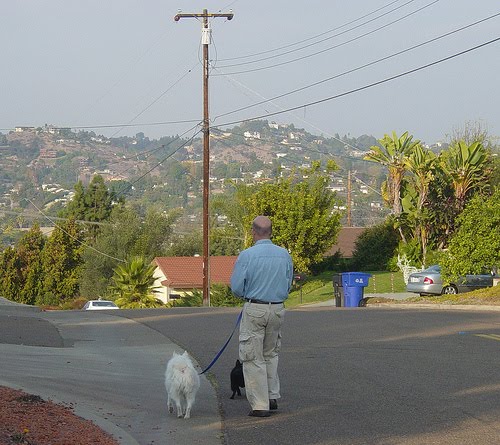
It is so nice for the shepherd to have sheep that listen to his voice and respond to his commands right away. I wish I had a dog that paid me such focused attention. But all I have is Jabba, and she is a dog who pays attention to my voice when it suits her. When she wants a walk she is very attentive to me. She will put her paws on my leg and bark for a walk. When I put the leash on her and we go outside, she almost immediately stops to sniff something. I say, "Let's go Jabba. Don't you want to walk?" In fact I have things to do other than walk Jabba. But she ignores me. If I pull on the least, she pulls in the opposite direction. Eventually, she looks up at me as if to say, "Oh, are you still here?"

I have come to realize that my attention to God is about what Jabba's attention is to me. In the morning, when I wake up, I tell God that I will be attentive to God and to please walk with me through the day. Then I go about my business, sniffing at this or that project, and forget about God. Now and again in the day I might recall, "Oh, God, you are still here." Then I promptly go back to whatever I was otherwise doing or thinking. I have ADD spirituality, a very short attention span for matters of the Spirit.

I wish I were more like the sheep in the Gospel, who are always attentive to the shepherd, but I am not. I am just an imperfect human being. So what is the Good News for me? The Good News is that God never abandons me even if I ignore the Presence. I have Jabba on a leash. I will not abandon her. I will not release the leash and let her go off to get hit by a car. Jabba will someday die and she might get sick. These are things I cannot change, but I will not abandon her otherwise.

God will not abandon me, though I will die and will get sick from time to time. God's Presence is not a reward for my being attentive. It is rather God's unconditional love that is always available for me to enjoy. Parish churches are good shepherds. If you only occasionally attend worship services, the church does not go away. It is going to be open and available to you whenever you decide to go there.

Regardless of my response to Divine Love, God's response to me is always, "I love you." I hope someday to better attend to God's love, than Jabba attends to me on our walks.

Thursday, April 22, 2010

God is One with us


In John 6: 44-51, Jesus says that "No one can come to me unless the Father...draw him/her." This means that the experience of union with God is a Gift. Our spiritual practice of centering or mantra prayer, can make us more receptive to the experience of union, but it cannot control God. A person can be suddenly enlightened, without any practice at all.
It also says in this passage of Scripture, "They shall all be taught by God." There is no intermediary teacher for the experience of God. Teachers can inform us about doctrine, which are "about God" but not God in God's immediate Self. Teachers can show us a practice of letting go of thoughts and images of God, but they cannot control God.
God is already One with us, but we just don't know it in an experiential way.

Monday, April 19, 2010

Upcoming Schedule

MASSES:

Monday, April 19 - 12:10 pm - Sacred Heart of Jesus

SATURDAY, May 1 - 5:30 pm - Lyons (Meets in Methodist Church @ 4th & Main)

SUNDAY, May 2 - 7:00 am, 8:30 am, 10:30 am Spirit of Christ, 7400 W. 80th Ave., Arvada

SATURDAY, May 8 - 5:30 pm - Lyons

SATURDAY, May 15 - 5:30 pm - Lyons

SATURDAY, May 22 - 5:30 pm - Lyons

SATURDAY, May 29 - 5:30 pm - Lyons


WORKSHOP:

Thursday, May 13 - 7-9 pm - St. Thomas Aquinas Church, 14th & Aurora St.

Until the beginning of the 13th Century there was little written by or about women on the subject of spirituality. With various changes in European society, women were better able to come to public notice with experiences of their prayer life. Some of these women were referred to as Beguines. They wrote in the vernacular for the laity, rather than in Latin for monks. They believed that all people could experience a deep presence of God without having to enter a monastery or a cloister. God could be found anywhere.

In this workshop, he will concentrate on one of these Beguines, Mechthild of Magdeburg. She wrote in a style with God as the author who is revealing the Gospel to women. Like Julian of Norwich, she had numerous visions or showings. Though a poet, she felt that all speech about God must end in silence. For her, the true desert is the everyday life. She had both consolation and darkness in her prayer life.

Refreshments will be provided along with opportunity for silent Centering Prayer. Suggested donation: $10. For more information, call Barbara Hayden at 303-494-2845.

Sunday, April 18, 2010

Third Sunday of Easter


JOHN 21: 1-19

APRIL 18, 2010

My mother never cared much for my beard. She did not say it, but I knew that she preferred me clean shaven. So on a recent trip to Vero Beach, Florida, where they once lived and died, I shaved my beard, took the shavings to a pond near where they had lived and tossed the shavings into the pond. It was a present to my Mom.

Had she asked me, "Terry, do you love me more than your beard?" I would have answered her much like Peter answered Jesus. "Mom, you know that I love you," I would have said. But that was not the question. My Mom, if she had ever asked me this question would have been trying to bring me to a decision: the beard or Mom, what is my choice. My answer would have been trying to have it both ways, and not change a thing.

Jesus asks Peter if he loves Jesus more than all these fish that Peter caught. While they were all having breakfast, Jesus could see that Peter was eyeing all those fish sitting on the beach, losing their freshness and market value. It is all well and good that Jesus is risen, but Peter is first a fisherman. He wants to love Jesus and change nothing about his own life, so Peter says, "Yes Lord, you know that I love you." He does not direct his answer to the question of choice. He wants fish and Jesus. This is our spiritual struggle. What priority does Christ hold in our life? This can be a lifelong struggle.

The Good News is that Jesus does not wait for Peter to make a choice in favor of Jesus. Peter is invited to ministry even while he struggles with this spiritual question. We do not have to be perfect for God to invite us to be a witness to the Good News of God's love and salvation. Sheep and lambs do not eat fish. Peter will not have to be a fisherman in the future to take up the invitation of Jesus. But even if he does continue to fish will he love and keep Jesus in mind even when the net is empty, and the tasks and projects of life seem to go nowhere?

God may invite us to do something new, but for most of us the invitation is to put God into the middle of our daily lives, especially when we seem to come up empty in whatever we do. How we respond to things not going our way is a tremendous witness to others who hunger for a God of love, and acceptance, who is with us in darkness and light.

Tuesday, April 13, 2010

A May presentation in Boulder


Beguines

Mechthild of Magdeburg

Her primary image of God is Flowing. She wrote in a style with God as the author who is revealing the Gospel to women. Like Julian of Norwich, she had numerous visions or showings. Though a poet, she felt that all speech about God must end in silence. For her, the true desert is the everyday life. She had both consolation and darkness in her prayer life.

Fr. Terry Ryan, CSP

Thursday evening, May 13

7 to 9 PM

St. Thomas Aquinas Church

14th and Aurora Street

Boulder

Sponsored by Contemplative Outreach of Boulder. $10 donation. Refreshments will be provided along with opportunity for Silent Centering Prayer. For more information contact Barbara Hayden at 303-494-2845

Monday, April 5, 2010

The Real Presence

LUKE 24: 1-12

APRIL 4, 2010 EASTER

When we are very young, parents and teachers try to pass on the faith to us. They give us information in the form of catechism answers, even if we are not asking questions. We might also enter into church pageants and events along with going to mass and receiving sacraments. But at some point, the facts and experience we have must come up against new information and events. For a time we will struggle and wrestle with new information. But in this time of friction between what we were told as children and what we are learning as teens and young adults, God seems to act. The rubbing of different ideas gives God's fire a chance to truly ignite a faith that will now be ours and not just that of our parents/teachers.

In the gospel for today, the women have some facts. Jesus is dead and buried. They saw this. They don't believe anything beyond this. Then they receive unexpected and new information. The stone is rolled back and Jesus is not in the tomb. Old information and new information rub against one another. The women are "puzzled' or "lost" as to what to make of this. They stand in the shrine of a tomb where Jesus was buried. The Spirit's fire ignites when things look pretty dark. Two men are seen in dazzling garments. Fear overcomes us when something of the Holy intrudes powerfully into our lives.

The men ask them why they are hanging around the shine among the dead? The two men remind the women of what Jesus told them. Memory is jogged about past information, but now it takes on a new meaning. The women are having a religious experience of faith. Now they are energized to go and tell someone what they have experienced. When our faith is only that of our parents we are not much interested in telling anyone anything about it. The women go and tell the disciples who don't believe them. It is not important that anyone respond to shared faith. It is only important that it be shared. The results are up to God. The men are not ready for new information. They are stuck.

If we are open to new teaching, information, experience, then we too will make faith our own in feeling and practice. Here is an example. We believe that the Eucharist is the precious body and blood and Jesus. We are told this and given training on how to reverence the host when we receive or have a devotion to the Eucharist. We spend lots of time cleaning out cups and bowls after communion so that no crumb or drop is lost.

But there is another teaching that is more muted. We are the precious body and blood of Christ. When the community gathers together for worship, Christ is in our midst, in each of us and all of us together. The gathered community is a primary presence of Christ before any mass consecration takes place. This idea, a teaching of Vatican II, caught fire in 1570 when Pius V excommunicated Queen Elizabeth. She got upset and decided to enforce the closing down of churches and worship for Catholics in England. There were no more tabernacles and no more public masses of consecration. There was no precious body and blood of Jesus to be found except in secret masses.

The people gradually began to see, in their private devotions, such as the rosary, that they were the tabernacles of God and that they were the sacred presence of Christ. Rome approved of this. What can happen if this teaching takes route in you? If you begin to see first yourself and then others as the precious body and blood of Christ, you might begin to treat people with more reverence, kindness and tenderness. I have seen when some people go to mass a lot and receive communion a lot and show great respect for the communion they receive, but then go out into the world and act in a selfish and unkind manner. They prefer to sit in shrines/churches, and say their private prayers, rather than to be Christ in the world. We are not meant to spend all our time inhabiting shrines, holy places. The two men in the gospel told the women this. We are shrines and temples of God's presence, and so are the persons we encounter in our daily life. Until we get this we are not going to be much good news for anyone.


Why do I always hear that we want more Catholics to come back to Church? They all came back on Easter Sunday and we had no space for them and their cars. The experience of the "special day" Catholic in a worship service is often one of an endless search for parking, and no place to sit. Sometimes we have a second mass in a gym. it is all kind of "gym looking" with the bleacher seats to boot. No wonder they don't hurry back!